The Vargas Case in Jersey City: A Historic Voting Rights Struggle from 40 Years Ago
Juan Cartagena
Civil Rights Attorney
Former Director of PRLDEF/Latino Justice
One: Intro
Forty years ago, in an election in June 1985, black and Puerto Rican voters of Jersey City overcame a concerted effort to deny them the right to vote because of their race and national origin. They came out to vote for the challenger, but the incumbent was hell bent on not relinquishing his seat. They saw right through the racially targeted tactics of rough Hudson County politics led by Mayor Gerald McCann and his campaign officials, abetted by the Hudson County Board and Superintendent of Elections.
They said hell no.
They waited to vote.
They protested new identification requirements.
They waited on long lines after getting court orders permitting them to vote.
They maneuvered around sabotaged elevators in the projects.
They ignored fake official notices threatening them with felonies if they tried to vote but their name wasn’t on their lease.
They went home and returned with more forms of ID. And they brought their uncles, titis, sisters and brothers to wait. To vote. To stop the in-your-face attempt to thwart democracy.
They won. “Slow down the vote” lost.
Mayor McCann, forced into a runoff election against Anthony Cucci, was stopped despite the outrageous, Jim-Crow-Mississippi-in-Jersey-City tactics his campaign undertook to “slow down” the black and Puerto Rican / Latino vote that rejected his candidacy 30 days before. His campaign attempted to steal an election by consistently targeting the Latino and black vote for voter intimidation and harassment.
This is just one history of those events. It is a history of black and Puerto Rican solidarity. Little has been written about it, post. One version is found in a fictional take of Jersey City elections called The Legacy of Haguesville. Whether fictionalized or documented, it is a history I know well. I saw it. Weeks later, along with other incredible lawyers, I represented the voters who sued to ensure that June of 1985 didn’t happen again.
Tracing the right to vote in the U.S. is always a study in exclusivity. Historically, New Jersey is no different than the majority of the thirteen colonies who conditioned the right to vote on wealth and racial qualifications. The Constitution of 1776 limited voting to men with a certain net worth. In 1844, the constitution was amended to limit the franchise only to white men above the age of 21; that racial classification was then eliminated in 1875. Women were not allowed to vote until passage of the 19th Amendment to the U.S. Constitution in 1920. And all persons convicted of felony crimes were disqualified as early as 1844.
But Election Day in June 1985 was all about interfering with the rights of eligible voters, particularly those African-American and Puerto Rican voters who voted against the incumbent mayor and the local Democratic Party machine in favor of another Democratic challenger.
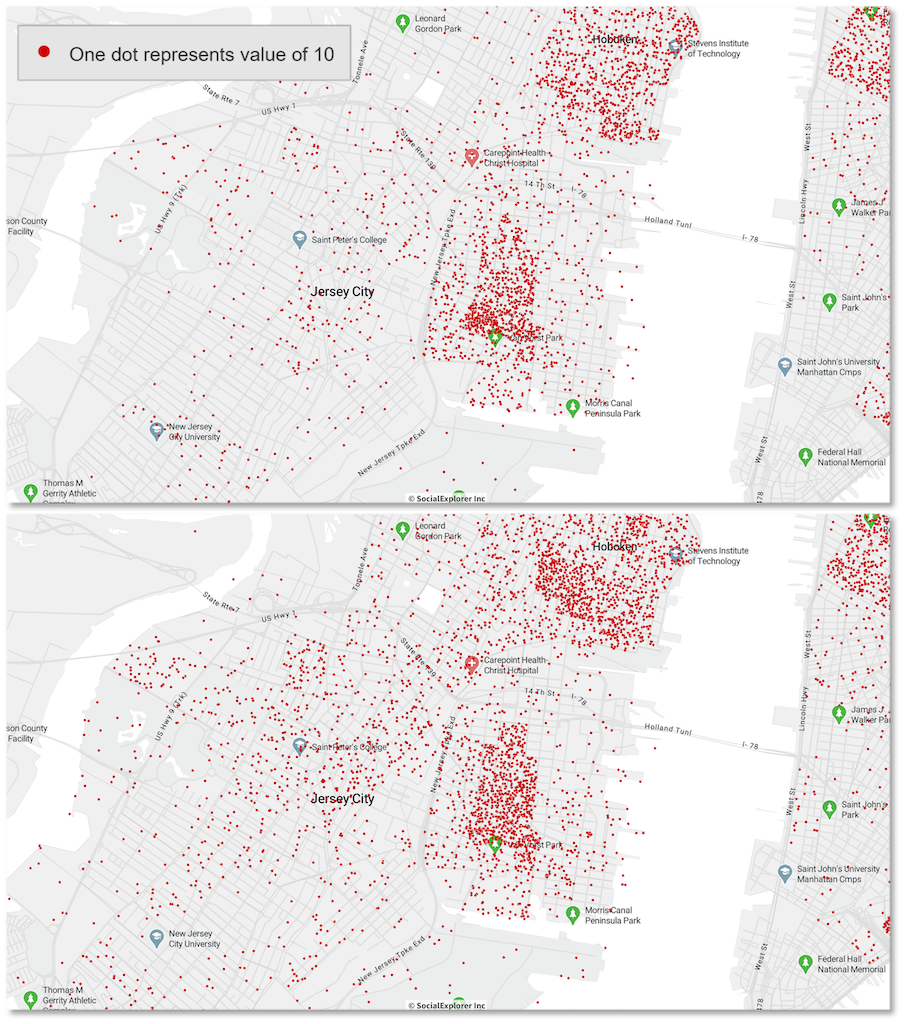
In 1985 Jersey City’s Puerto Rican population was ascendant. The 1980 census pegged the population at 26,830 on its way to its peak population of 30,950 in 1990. The African-American population in 1980 was growing too, numbering 61,954 on its way to 67,864 in 1990. Combined, Jersey City was 40% black and Puerto Rican in 1980 and 43% in 1990. Of the City’s six municipal wards, A through F, each one had at least a 20% black and Puerto Rican share but Ward E in Downtown was close to 70% black and Puerto Rican while Ward E in Bergen Lafayette was close to 90% black and Puerto Rican.
Downtown is the name we use to describe the part of the city that is closest to the Hudson River. It is not synonymous with the business center of town as the term is used in other cities. Uptown was the name we used to describe the parts of Jersey City that lay slightly west and on the southern edge of the Palisades cliffs. Downtown was a simple way to describe topography and from the 1960s through the early 2000s it was the epicenter of Puerto Rican life in the city.
Political representation took a while to gain traction for the city’s Puerto Ricans. Carlos Veguilla was the first candidate to run for City Council in 1965. Perfecto Oyola ran as an independent for Congress in 1972. Raquel Amalbert was the first Puerto Rican woman to run for any office – she ran for a County Freeholder seat in 1972. The county legislature did have a Puerto Rican member – a historic first – by way of the Rev. Fernando Colon. Ben Lopez made history as the first Puerto Rican elected to the City Council in 1981 and Nydia Davila-Colon made history as the first Puerto Rican woman ever elected in Jersey City when she won a term as a County Freeholder in 1983. In May 1985 Jaime Vazquez was elected to the Jersey City Council on the Cucci ticket, rounding out the landscape for Puerto Rican representation during the disgraceful events of June 11.
McCann was Jersey City incarnate, Irish and outspoken. He cemented his legacy in dog-whistle politics by approaching and crossing the proverbial line several times in his career. Black and Puerto Rican voters would never forget his unabashed so-called solution to the city’s problems in 1979: force all poor people out of Jersey City he said. That would solve the city’s problems. The city was deeply white ethnic with long-standing Irish, Italian and Polish communities. McCann was dog-whistling about people of color.
Puerto Ricans and African-Americans ousted Mayor McCann in 1985 after only one term, but this is Jersey City, and he wasn’t going to take this smack-down lightly. Hell, he would not even leave the premises without making a statement for the ages. There were only two weeks between the runoff election on June 11 and the July 1, 1985 start of the new mayoralty. Anthony Cucci planned for midnight, July 1st swearing-in as a way to stop McCann from officially reappointing his friends to boards and commissions after the fact. Then a bomb scare was reported to the police. Cucci had to wait till morning only to find that the rugs in the Mayor’s Office were soaked with urine, glue was squirted into every office door necessitating a locksmith, desks and chairs were overturned, and a file cabinet went missing. McCann denied pissing on the rugs or having anything to do with the defilement and sabotage of the Mayor’s Office. Everyone blamed him and his team anyway. “He was a class act” Helene Stapinski would write, mocking McCann’s innocence.[1]
This is the Jersey City that I know. It is my hometown. I was a young attorney at the Puerto Rican Legal Defense Fund and had already tasted what impact litigation can do to help Puerto Rican voters when the first case I signed on to at PRLDEF stopped Ed Koch and the New York City Council from implementing a discriminatory redistricting plan that robbed Puerto Rican voters of their collective voting strength. Downtown Jersey City was lit on the night of June 11, 1985, with streets full of protesters turned revelers after it was announced that McCann lost. In the weeks that followed I was called to help investigate the outrageous forms of voter intimidation that his campaign undertook. Calls from my activist partner, JoAnn Chasnow from Human SERVE and from the American Civil Liberties Union of New Jersey made it clear that as a voting rights attorney, I had to respond to this episode of racist behavior.
It took nine years to finally resolve the suit, compensate voters, and, along the way, change the way future elections were conducted in Jersey City, in Hudson County, in New Jersey.
This is my chronicle in nine parts.
Two: The Ones Who Stepped Up
The lawsuit was called Vargas v. Calabrese. Seven Jersey City voters stepped up and sued the Hudson County Board of Elections (chaired by Christine Calabrese), the County Superintendent of Elections, Joseph Brady, plus Gerald McCann and a number of his campaign operatives: Mark Munley, Matthew Burns, Jack Finn for intentional race discrimination and violations of the Voting Rights Act. Claims were also filed against the Board of Elections for failure to provide bilingual assistance in Spanish.
Each of these voters deserved to be remembered:
Josephine Vargas: Ms. Vargas lived at her same address for four years and voted in the municipal election a month before in May 1985 with no problem. At her polling site, she was told everyone in her building would be challenged, categorically. After showing multiple forms of ID, she was not allowed to vote and told to get a court order. She was unable to do so and never voted that day.
Jo Ann Wheeler: Ms. Wheeler lived at her address for nine years and voted regularly. She was told she was on a challenge list produced by the Board of Elections. After showing her rent receipt, sample ballot, telephone bill, utility bill, and after much arguing, she was not going to take no for an answer. She finally was allowed to vote.
Martin Ellerbee: Mr. Ellerbee lived at his address for seven years and voted with no problem in the Democratic primary just days before the runoff in June. He was told he was ineligible to vote and not given a reason. Believing that it was too late to go to court after 5pm, he never cast a ballot that day.
Marion Gargiulo: Ms. Gargiulo voted in the municipal election held the month before and lived at the same residence for six years. It was across the street from the voting place and yet she was told neither her, her husband or her son would be allowed to vote. She went home, got multiple forms of ID and was finally allowed to vote.
Janice Sellers: Ms. Sellers had to get a court order finally allowing her to vote at 7:15 pm after being challenged based on her residency even though she voted in the last two elections less than 30 days before.
Maria Rivera: Ms. Rivera lived in public housing for seven years and also voted in the municipal election the month before. Despite this, her residency was challenged. Like everyone in public housing she received an “official letter” warning her that if her name was not on her lease and she attempted to vote she would be prosecuted. Her name was on her lease, and she was still denied the right to vote. After 3 hours in the courthouse, she finally got a court order and cast her ballot.
Margarita Gonzalez: Ms. Gonzalez produced her sample ballot with her name on it after being challenged on residency grounds. She lived at her address for three years and voted successfully the month before. Ms. Gonzalez was unable to get assistance in Spanish but eventually learned she could get a court order to vote. Unfortunately, she got to the courthouse too late and was unable to cast a ballot.
These voters were represented by Samuel Issacharoff, an attorney with the Lawyers Committee for Civil Rights in Washington, DC; Lauren Anderson, an attorney with the New Jersey American Civil Liberties Union in Newark, and me when I was an attorney with at PRLDEF in New York City.
These seven courageous African-American and Puerto Rican voters stood up for justice.
They made history in Jersey City.
Sam Issacharoff, a young attorney who went on be a tenured law school professor, and I stood with the case for the entire ride: nine years of litigation, discovery, motion practice, press conferences, witness prep, election monitoring, settlement negotiations, special master proceedings, appeals, and final validation. We sat over beers at one point a few years into the lawsuit and committed to take the case with us no matter where we happened to land in our new and unfolding careers. Whenever I interviewed for a new job, I would insist that my work on the Vargas litigation was a condition for employment. It’s a story I tell law students. Litigating a case like Vargas is rare, but so were the facts that led to filing the suit, the twists it took, and the incredible impact it had on voting rights and election law. It became one of the most rewarding cases I ever worked on. And it was for Puerto Rican and African-American voters right in my neck of the woods.
Three: Intimidation Planning
Runoff elections, by definition, provide ample evidence of what went wrong in the first round for candidates hoping to win outright. For incumbent Mayor McCann the May 14, 1985, election was a shocker: He lost to Anthony Cucci by 1,626 votes. At least he forced a runoff. One obvious takeaway was that Anthony Cucci garnered the vast majority of votes cast in heavy black and Puerto Rican neighborhoods, including the public housing sections of town. Puerto Ricans in Downtown were clearly rejecting the incumbent.
Two major players in the Puerto Rican community were running for council seats but on opposite tickets: Jaime Vazquez, the firebrand maverick and former U.S. Marine and Eliu Rivera, an institutionalist who was leading the most comprehensive Puerto Rican social service and housing organization in the city, PACO (Puertorriqueños Asociados for Community Organization). Vazquez was running for the Downtown Ward seat on the Cucci ticket. Rivera was running with McCann for an At-Large council spot, but his base was Downtown where Puerto Ricans dominated.
Strategically, for McCann to win, his base had to be mobilized to turn out in higher numbers. That should have been enough except that McCann’s campaign decided that more votes in the white sections of the city along with less votes in the black and Latino sections of the city would be a better winning strategy. So they embarked on a “slow down the vote” strategy targeted at black and Puerto Rican voters after a full statistical analysis of the tallies of every election district in the city. Realistically, you can only slow down voter turnout by either rendering vote machines inoperable or unavailable. Alternatively, you create chaos at polling sites by excessively challenging voters at the polls, fomenting frustration that would lead to long lines and voters abandoning their plans. The McCann crew opted for targeted voter challenges against blacks and Puerto Ricans.
Of course, the McCann campaign needed cover, so they alleged rampant voter fraud in the May election where Cucci nearly won the mayoralty. Voter fraud is exceedingly rare in the U.S. and even in places with reputations for corruption like New Jersey. To grease the skids in their favor the McCann campaign had to move fast with only four weeks for the runoff. Policies had to be changed, rules bent, loyalty demanded for the person who was both the Mayor of the State’s second largest city and the Chair of the Hudson County Democratic Party.
McCann pressed all the buttons: Dead people voted in May. Voters listing empty lots as their homes voted. Voters in the public housing projects voted fraudulently. “There were hundreds and hundreds of Hispanics who voted illegally” in the runoff McCann charged.[2] An investigation was called for so he began his own. Then he demanded that Joseph Brady, County Superintendent of Elections begin his own. Matthew Burns delivered names of alleged fraudulent voters who voted from empty lots but Brady didn’t heed them. Instead, he found another way to put between 5,000 to 6,000 voters on an official challenge list based on whether sample ballots mailed to those voters before the May 1985 election were returned as undeliverable. Never mind that many eligible voters voted in May 1985 and in the Democratic Primary election of early June 1985, each time declaring and reaffirming their identity and eligibility to vote. No. Thousands of suspect voters were put on the official list with no notice. After the Vargas suit was filed it was clear that many of these voters did receive sample ballots in the mail as per affidavits from Joann Wheeler and Josephine Vargas.
The McCann campaign was undeterred. They got the Executive Director of the Jersey City Housing Authority, Robert Rigby, to investigate the leases of all persons who lived in the projects. Then they sought to have Rigby forward the names of all residents of the projects not on their respective leases to the FBI and the County Prosecutor for possible prosecution.
Jack Finn was brought aboard to devise a statistical analysis of where votes had to increase and where votes had to decrease. Election districts where turnout had to be minimized were labeled “Challenge Tough.” In the heavy Puerto Rican section of the city (Ward E), 23 out of 25 election districts were deemed Challenge Tough; in the heavy black section of Jersey City (Ward F), 24 out of 25 election districts were labelled Challenge Tough.
None of this would have come to light if not for excellent local reporting led by Mike Garrity and Richard Rosenberg of The Jersey Journal. They wrote a three-part series of articles that uncovered the failed and illegal strategy to deprive Black and Puerto Rican voters of the right to vote. The articles documented the lengths that McCann’s campaign undertook to steal the election. The Vargas suit followed the leads of these reporters and, through discovery, corroborated a litany of outrageous, tactics aimed at stopping black and Puerto Ricans from voting for Anthony Cucci.
The Board of Elections chair, Christine Calabrese, an avid McCann supporter, devised a new identification policy written solely for the June runoff: a driver’s license alone was no longer valid proof of ID. Instead, two additional forms of ID were required of any voter challenged in the election. The memo was unsigned but still distributed citywide to all poll workers. Well after the runoff, Calabrese claimed it must have been “a mistake, or a typo or something” to demand two additional forms of ID.[3] Her colleague, Superintendent Brady proceeded to throw her under the bus in an affidavit he submitted to the courts months later: the new policy was only shown to him in draft form, it was never approved by the full Board of Elections, and he didn’t see the final version until the afternoon of Election Day, June 11.
The Board of Elections’ complicity in the fraudulent abuse of voter challenge procedures continued. It allowed the Hudson County Democratic Party, chaired by McCann, to substitute poll workers at the last minute with hand-picked replacements. The poll workers that were displaced had worked their local polls for years and knew many of their voters by name – the majority of them were black and Latino. The Board of Elections processed these changes even though municipal elections in Jersey City were nonpartisan.
Worse yet, many of the new poll workers were white, off-duty Jersey City Police officers deployed in black and Puerto Rican neighborhoods. Almost all of them – 30 in all – were members of a club called “Public Safety for McCann.” McCann had locked up police support for his candidacy well in advance. After all, his campaign manager, Richard Harrison, was the head of the Jersey City Police Department. Board Chair Calabrese was directly involved in deploying the substitute poll workers, but it was reported that the idea originated with campaign attorney, Matthew Burns. The Cucci campaign challenged these appointments in court at the last minute but was only able to get one concession: the off-duty police could not be armed or in uniform when they worked the polls. Nonetheless, voters witnessed some of these white police officers wearing ankle holsters and firearms as detailed in an affidavit from Glenn Cunningham, a member of the Cucci slate who became, eventually, the first African-American Mayor of Jersey City. Once the local court permitted the change, the Board of Elections washed its hands of its role in the last-minute substitutions.
Pre-Election tactics continued by the McCann campaign. If you lived in the public housing projects, you received an official-looking notice warning you that if you try to vote in the June runoff and your name was not on the lease you would be prosecuted. Both the Board of Elections and the Jersey City Housing Authority denied authorship. The warnings arrived days before the runoff, slipped under apartment doors, stuffed into mailboxes. No one admitted doing it, but the telltale signs were that they came from the McCann campaign.
All hell promised to break loose on June 11, but no one could have predicted the magnitude of these illegal attempts to steal an election by thwarting black and Puerto Rican political strength.
Four: Election Day Locura
On Election Day, June 11, 1985, voters who lived in the Duncan and Curries Woods projects, two sites with large black populations, woke up to learn that their elevators were tampered as to make them inoperable. Their electrical panels were ripped off. “Deliberate sabotage” was how Robert Rigby described the removal of electrical panels in the elevators.[4] It was the first sign that Election Day was going to be a long day.
The substitute poll workers, nominated by the McCann campaign and appointed to serve by the Board of Elections, began challenging voters en masse, alleging that they didn’t live where they said they lived. Many voted just days before in a Democratic primary election in June. Many voted 30 days before in the general Mayoral and Council election. It didn’t matter. McCann campaign representatives challenged the bona fides of their residency and the new polling workers upheld the challenges. When the McCann campaign workers didn’t object directly, the new polling workers challenged voters themselves. One off-duty officer challenged 15 Latino voters in a row in Downtown. He was temporarily removed but eventually allowed to return.
“Slow down the vote” was the handwritten directive made by Mark Munley and others during the runoff election. Excessive voter challenges were the result. When the 3pm early results came in showing decreased turnout in Ward E – Downtown and Ward F – Bergen/Lafayette and increased turnout in the Heights and Greenville where McCann had strength, a smiling McCann told reporters “I’m bringing it out where I’m supposed to and keeping it low where I have to.”[5]
The chaos created by the McCann campaign and its complicit partner, the Board of Elections, required immediate federal court intervention. Superintendent Brady was called by U.S. District Court Judge Ackerman that day in response to reports of excessive and discriminatory voter challenges. Brady admits to Judge Ackerman that “it appeared that some district board members were demanding too much by way of identification at the polls.”[6] He then agreed with Ackerman that if the voter was on Brady’s challenge list a driver’s license along with other proof is sufficient and if the voter was challenged only by a district board member (aka, poll worker) or McCann challenger then a driver’s license alone was sufficient. Brady then communicated that new order to Joseph Healy, Corporation Counsel in the McCann administration and eventually lead counsel for McCann in the subsequent Vargas suit, in the hopes that Healy would relay it to police officers stationed at every site, who would then relay it to all district board members – some of whom were their colleagues on the police force and already major supporters of the McCann campaign. Go figure.
Downtown Jersey City, the heart of the City’s Puerto Rican community at the time, was subject to incredible efforts to steal the election. Jaime Vazquez, Cucci’s running mate for the Ward E council seat won his election outright in May. That left only Eliu Rivera, head of PACO, as the remaining Puerto Rican on the ballot – but he was running at-large on the McCann ticket. Mike Torres, a McCann field worker minted for his knowledge of the Puerto Rican community, told reporters afterwards that the message from McCann campaign leaders was clear: “the idea was to slow down the vote.”[7] He added that every Latino voter who did not sign a petition nominating McCann for Mayor or Rivera for Council, would be challenged. Deliberately. Some challengers went overboard and challenged everyone who looked Latino. Campaign officials denied that the strategy was to target the Latino vote and tried to cast blame on Torres. But Torres was clear that the slow down the vote strategy came from the top of the campaign.
One more inexplicable tactic was uncovered by Garrity and Rosenberg of The Jersey Journal that revealed how much the campaign intended to stop Puerto Ricans from voting for Cucci. A record-breaking $35,000 of street money cash was spent in Downtown alone on Election Day. Street money typically pays for assisting voters to get to the polls and back, or to the courthouse to get court orders. It also pays for field volunteers to drum up interest in the election. Instead, in Downtown the strategy was to dampen Puerto Rican turnout, limit participation, and slow the vote. Torres remarked that Downtown bars received big money to keep patrons drinking steadily and away from the polls. McCann’s focus on Downtown was obvious: Bergen/Lafayette received $13,700 in street money – that number was also staggering – while every other ward received between $5,000 – $7,000 in street money from the McCann campaign.
From every vantage point, it appeared that Puerto Rican voters held the key to the mayoralty.
Since the new polling workers were strangers to the regular voters who had been voting in the same election site for years, their intimidation game became obvious. What also became obvious was that African-American and Puerto Rican voters were not going to take this attempt to steal an election lying down. Lines formed. Patience reigned. Voters went home to get more ID and spread the word that white, off-duty police, were intimidating voters with bullshit challenges to their residency. The lines got longer. Cucci campaign workers transported voters to the courthouse. Of the close-to 6,000 voters on the official challenge list, 3,000 were challenged, and 1,200 received court orders from Hudson County Superior Court reversing those challenges.
Night came and early results proved that the McCann strategy was a complete failure. In Downtown, the sounds of the streets were celebratory. Cucci supporters began amassing in key areas. Soon a makeshift cardboard coffin emblazoned with the name McCann was leading an impromptu march of voters and campaign workers.
Hudson County’s reputation for hard core, bare knuckles politics, was enhanced in June 1985. But so was the resistance shown by Puerto Rican and black communities in Jersey City. On this occasion, the Democratic political machine could not protect one their own.
Slow down the vote lost. A new mayor would soon take over.
Five: Only One Lawsuit
Garrity and Rosenberg, the reporters for The Jersey Journal, were swamped with tales of the night of June 11, 1985. Their reportage uncovered details that would rival Jim Crow tactics from the Deep South. The targeting of black and brown voters was clear.
Election day sabotage of the elevators. Fraudulent warnings on official letterhead. White officers working as poll workers armed with ankle holsters. An official voter challenge list that was never published until Election Day depriving voters of their vote with no due process. Rules bent. Rules broken. Handwritten messages from McCann campaign operatives to deliberately slow the vote in districts where black and Puerto Rican voters lived. County election officials doing the bidding of the incumbent mayor in order to tilt the election based on unsupported allegations that black and Puerto Rican voters committed voter fraud in the previous mayoral contest 30 days before. All of these acts rise to the level of state and local crimes: voter intimidation, intentional interference with voters and conspiracies to engage in these activities lead to criminal liability.
The signs of a conspiracy to deny civil rights were there, and yet … crickets from the Hudson County prosecutor. Same from the U.S. Attorney’s office in Newark. No one was charged with any criminal violation. The Jersey Journal editorialized that local, state and federal authorities were obligated to investigate to see if civil rights laws were violated. And yet, no indictments, no arrests.
Instead, one lawsuit was filed. An ambitious one, no doubt. But the attempt to deny the vote – the very vote that people shed blood over and led to the enactment of the Voting Rights Act of 1965 – of African-American and Puerto Rican voters, brazenly and openly, could not be left unchallenged.
The Vargas suit alleged a conspiracy to deny the civil rights of these voters in a large class-action filed before Judge Dickinson Debevoise in federal court in Newark. Judge Debevoise previously handled the 1981 civil rights lawsuit by the Democratic National Committee against the Republican National Committee that challenged Election Day intimidation tactics by the RNC in federal elections in New Jersey. That case documented how Republicans created a “Ballot Security Task Force” composed of armed guards who were deployed to minority neighborhoods. Debevoise extended the consent decree to continue the monitoring of RNC tactics for decades to come. In short, Judge Debevoise had seen this unseemly game before.
The voters demanded that the federal court issue orders against the Board of Elections so that voter challenge procedures would never be subject to discriminatory targeting and last-minute manipulation. The suit also demanded full compliance with the bilingual voting requirements of the Voting Rights Act which, since 1965, protected access to Puerto Rican voters to vote freely in Spanish. Finally, the suit demanded an unspecified amount of monetary damages to compensate black and Puerto Rican voters who were denied the vote and/or harassed or delayed in casting a vote because of their race and national origin.
Judge Debevoise certified that the class of voters who would be represented in the Vargas case included “all black and Hispanic residents of Jersey City who were registered and qualified to vote on June 11, 1985, whose right to vote in the June 11, 1985 election was interfered with because of their race or national origin, or candidate preference.”[8]
The Vargas suit also sought to certify a class of defendants who were poll workers and McCann challengers that day. The attempt to establish a class of defendants, just like the conspiracy claims against the Board of Elections, was eventually rejected by Judge Debevoise. But the core of the suit remained.
They are “coming after” me because I’m white, said McCann in response to the suit. He threatened to sue the lawyers who filed it.[9] “Ask me what democracies exist in countries that are predominantly minorities. There’s not one democratic country in all of Africa. They mostly all have military governments.”[10] McCann was the victim, not the hundreds of voters he claimed should be challenged repeatedly.
Six: The Settlement
Securing monetary compensation for victims of voting rights denial is very rare in civil rights litigation. The Vargas suit was proceeding in mostly uncharted waters on that score. Most Voting Rights Act cases are successful when they secure injunctive relief – court orders that create new policies and procedures that avoid the replication of what led to the suit in the first place. In Vargas that meant forcing the County Board of Elections to change both their voter-challenge and language assistance practices. The plaintiffs clearly wanted those reforms, but they also wanted compensatory damages to address what they suffered through in the election. And they wanted compensation not just for the seven of them but for the class of plaintiffs that Judge Debevoise certified, potentially 1,400 voters in all. Compensatory damages would provide some relief for the emotional distress, abuse, torment, humiliation and harm to their dignity and self-esteem. Punitive damages, on top of this, were also sought in the lawsuit.
After four years of litigation, with deposition testimony from 20 witnesses surpassing 4,500 pages, and tons of motion practice on both sides, the parties started negotiating a possible ending to the battle. Magistrate Judge Ronald Hedges created the space to begin meetings and addressed issues that were complex with so many affected voters involved.
Eventually in 1990 the parties settled all of the claims in Vargas. The Board adopted limitations on the ability of poll workers to challenge or accept challenges based on residency in a particular area or in public housing. Voter challenges had to be recorded. The list of acceptable forms of identification was greatly expanded beyond what was implemented in the 1985 election. The Board agreed to improved methods for recruiting bilingual district board members to work the polls and assistance to Spanish-dominant voters was enhanced.
Defendants McCann and Munley individually agreed that in future elections that they were involved in that “no voter shall be designated for special challenge based on a voter’s race, color, ethnicity, creed, or residence in the housing projects.”[11]
What made the settlement unique, as if the facts weren’t enough, was that $590,000 was secured to create a pool of dollars for damages for the plaintiff class. The source of the funds was a settlement with one defendant for $45,000 and an additional $545,000 that represented the proceeds of a regular liability insurance policy covering the McCann campaign. The first defendant to settle and pay into the pool of damage awards was Matthew Burns, a lawyer in private practice and one of decision-makers of the campaign. Burns agreed to pay $45,000 of his own money and, if the campaign insurance coverage was upheld, he would pay an additional $45,000. Burns later said that given the communities that he works with he was “personally uncomfortable in the position of being a civil rights defendant.”[12] I guess shame was still alive in the rough arena of Hudson County politics.
Jack Finn entered into a settlement that did not add any funds to the pool, but where he instead agreed to testify at trial as a witness for the plaintiffs.
Defendants McCann and Munley agreed in their individual settlements to transfer $250,000 each – to be paid by the insurance proceeds of the policy the campaign purchased from National Union Fire Insurance Company of Pittsburgh, PA.
In short, a run of the mill, slip and fall policy that also covered personal injury and acts like defamation, that cost only $750, presented a potential pool of significant dollars for African-American and Puerto Rican voters who were subjected to interference, harassment and intimidation on Election Day.
All defendants denied any wrongdoing, including denying intentional violations of the Constitution or the Voting Rights Act – standard fare in civil rights settlements. Throughout the litigation, McCann and all the defendants consistently denied committing any violation of law. McCann had more to say about this when he ran for reelection years later.
Settlements of any class action case require both court approval and approval from members of the plaintiff class. Judge Debevoise had to both review the terms and make judgements on how the settlements would affect the collective liability for the attorneys’ fees of the Vargas plaintiffs. Successful plaintiffs in civil rights cases usually recover their costs, including attorneys’ fees, if their suit results in a favorable outcome that changes policies, procedures or behavior by the defendants. There was never any question that the Vargas settlement did exactly that.
In January 1990 Judge Debevoise held an open hearing to decide whether to accept the class action settlement. The class of voters was notified through legal notices and newspaper ads in Spanish and English. No voter objected to the settlement. In a subsequent opinion, Judge Debevoise recognized that McCann and the campaign defendants were the focus of plaintiffs’ efforts to secure liability but that didn’t mean that the public defendants were absolved because they also played a role in the “election process that the remaining individual defendants had so grievously abused.”[13]
Nearly five years had passed since the attempted steal in 1985. Everyone agreed to the money and the reform. And yet, the litigation continued with appeals by the insurance carrier, National Union Fire Insurance Company. NUFI attacked the settlement as contrived, unsupported by the law, and as a product of a handshake deal to settle the federal case with someone else’s money. It even hinted that I and the other plaintiff’s attorneys were in on the sweet deal.
That position added years to the litigation.
Seven: The Insurance Money
It was no surprise that NUFI would refuse to accept the settlement reached by the parties in Vargas. Makes sense – they were on the hook for half-a million dollars for a pittance of an insurance premium. Rejecting claims is commonplace for insurance companies.
Insurance carriers have a legal duty to defend an insured when that person is sued and a duty to indemnify, pay, the insured for any liability resulting from acts covered under the policy. NUFI denied the McCann campaign’s request to provide it with legal representation leaving McCann and his operatives on their own. NUFI also denied all liability for amounts that McCann, Munley and Burns agreed to transfer to the plaintiff damages pool. This included not only the $545,000 in the damages pool but also the amount of the voters’ attorneys’ fees that the private defendants had to pay. Moreover, if NUFI’s legal position was denied on appeal, it would also be on the hook for the private defendants’ own attorneys’ fees since it denied providing counsel.
All this for a $750 premium: probably the best decision McCann ever made in his life.
It all happened in the normal course. “Professionals for McCann” and “McCann in 85” were the fundraising committees created to support the campaign which obtained the first policy. Lawyers for the campaign wanted a new policy to cover everyone on the campaign for anything arising from the campaign. NUFI staff knew that the committee would be raising money and gathering votes, and it issued a broad form endorsement policy in 1984. It covered bodily injury and advertising injury, such as libel or slander. Burns wanted to make sure all persons on campaign were covered.
In New Jersey, ambiguous terms in insurance policies are always interpreted against the drafters, here the corporation. Even though “civil rights actions” were not explicitly referred to in the NUFI policy, Judge Debevoise noted that what was in fact covered in context of a political campaign was ambiguous.
Was it reasonable for the McCann campaign to believe policy would cover civil rights actions? Yes, according to Judge Debevoise, who then proceeded to make a telling observation about Hudson County politics: “In the rough and tumble arena of Jersey City politics, it was not unreasonable that the campaign organizations would be targets of litigation including civil rights actions.”[14]
Let that settle in.
In effect, in Jersey City elections, damn-near anything can happen. Debevoise’s assessment of this reality was even parroted by McCann’s attorneys on appeal. Citing this very quote his attorneys argued that being sued for racially discriminatory election practices was foreseeable for NUFI when it issued its broad coverage policy to the McCann campaign.
It took seven Puerto Rican and black voters to make sure that brazen racially targeted challenges would not be part of the Jersey City playbook in future elections.
Once the amount of the damages pool was agreed to the only remaining big ticket item was how much the private and public defendants were required to pay counsel for the voters for their fees. Organizations like the Puerto Rican Legal Defense Fund and the Lawyers’ Committee for Civil Rights Under Law, where Sam and I were employed when we filed Vargas, do not charge its clients for legal representation. But when we win outright, or settle favorably, the organizations reap the benefits of attorney fee awards. Congress authorized the issuance of attorneys’ fees to prevailing plaintiffs in litigation filed under the Voting Rights Act and in all successful constitutional litigation. Equally important, the hourly rates for compensating us as public interest law attorneys is pegged to the legal market in that geographical area, including lawyers in private practice. This was established as a way to increase the cadre of attorneys willing to take on complex civil rights cases. Over the years of litigation, many lawyers, paralegals, and legal interns worked on the Vargas case. Sam and I had the lion’s share of hours and given the novelty and complexity of the case we asked the court to double our fees as a way to enhance the amount and set a precedent for future cases as difficult as Vargas was. We sought over a million dollars in attorneys fees in 1990.
Judge Debevoise was amenable, but not to the tune of a million dollars. He highlighted favorably the careers of Samuel Issacharoff, Lauren Anderson, Arthur Baer (also a PRLDEF attorney), and me. He recognized the significant amount of attorney time it took to get the Vargas case to the point of a successful settlement that included both institutional reform and a damage pool to compensate voters in Jersey City, noting: “In a case of this magnitude, were it being handled by private attorneys, the plaintiffs could reasonably draw upon the services of two law firms …”[15] Eventually he settled on a 25% enhancement, not the 100% we asked for.
Judge Debevoise then had to decide how to allocate responsibility for paying the plaintiff fees between the private defendants and the public defendants. He addressed their respective responsibility “for the transgressions which were the subject of the lawsuit and which were remedied by the final judgment in this case.”[16] Debevoise continued by noting that “…it is abundantly clear to me that the individual defendants were primarily to blame for the appalling events … to disenfranchise minority voters …”[17] He decided upon a two-thirds and one-third split. The Board and Superintendent of Elections were ordered to pay Vargas counsel $211,725. McCann and others, and by extension, NUFI, were ordered to pay $423,449.
By November 1990, NUFI’s exposure was now way in excess of a million dollars. It fought like hell. First, it attacked the bona fides of the settlement in a hearing before Judge Debevoise. The settlement was the product of collusion, it asserted. Mind you, its lawyers attended some of the negotiation sessions before U.S. Magistrate Judge Ronald Hedges. NUFI called me to testify before Judge Debevoise – my first time on a witness stand, ever. The courtroom interrogation was laughable. NUFI seriously thought that I was on the take with McCann to come up with a monetary settlement for baseless claims that would never be upheld in court. After losing the hearing, NUFI continued the fight on appeal.
It argued that no insurance policy can cover intentional actions that violate civil and constitutional laws without offending public policy. “If plaintiffs’ allegations are true, then defendants have committed a crime.”[18] It went on to argue that only the Attorney General can prosecute that, not plaintiffs in a civil action. The McCann defendants strongly denied that they committed any crime even as they argued that the policy covered intentional actions. NUFI then argued that plaintiffs could not have prevailed against McCann and thus, the settlements were excessive. This argument was on weak grounds. Judge Debevoise handled the case for years and had already denied the McCann defendants’ motion for a judgment in their favor. “The several lengthy opinions filed by the district judge in this case thoroughly explore the McCann defendants’ potential liability and the possibility of recovery well in excess of the settlement amount,” noted the appeals court.[19]
The appeals court did agree with NUFI, the McCann defendants and even the public defendants on one point: Debevoise’s 25% enhancement of the fee award to plaintiffs’ counsel was not necessary. Enhancements are reserved for cases where it was difficult to attract counsel. That was not an issue in our case because Lauren Anderson and I went out looking for clients to sue McCann and the election officials in the summer of 1985.
To the benefit of all future black and Puerto Rican voters in Jersey City, we found them.
Eight: The Impact
Vargas v. Calabrese has had enormous positive impacts from the immediate monetary relief that voters secured to changes in the Election Code of the State of New Jersey. Its legacy lives on.
Voter Monetary Compensation:
Once the NUFI appeals were over the case was returned to Judge Debevoise to implement his detailed orders on how to distribute the damages award of $590,000. Sam Issacharoff was the driver of a set of protocols that would allow money to get into the hands of voters expeditiously, without diminishing the pool through lawyers’ fees for attorneys for voters or the defendants. The dollars would be set aside until the Court assigned a Special Master to hear the accounts of voters who were harassed, delayed, and/or denied the right to vote on June 11, 1985. No lawyers were allowed; only the Special Master and the individual voter who would testify under oath. Every voter who could meet the criteria of membership in the class of voters certified by Judge Debevoise would receive a nominal damage award of $50. Those voters could also receive additional compensation depending on the severity of the interference of their rights on Election Day. The Special Master’s determination could only be reviewed by Judge Debevoise. No appeals were permitted. The cost of hiring a Special Master and administering the individual hearings would be paid through the damage pool of $590,000.
Judge Debevoise asked all counsel for recommendations on who could serve as Special Master. I recommended attorney Lourdes Santiago of Jersey City. Ms. Santiago was an accomplished civil attorney with experience in both legal services and private practice settings. As a Puerto Rican attorney raised in Jersey City, she was bilingual and knowledgeable about the city’s black and Puerto Rican neighborhoods. I have known Ms. Santiago for years. Judge Debevoise chose her.
Starting in 1993, Special Master Santiago proceeded to contact the original 1,396 members of the plaintiff class through bilingual mailings and public notices. Given the number of years that had elapsed, the potential class was first reduced to just over 600 individuals who were the subject of additional mailings to ascertain if they were eligible class members. These mailings were supplemented with outreach to community leaders in Jersey City, media placements in The Jersey Journal, El Diario – La Prensa, El Vocero, as well as Spanish radio. Santiago invited me to be part of the plaintiff outreach in these Spanish-language radio studios and arranged for me and one of my clients, Janice Sellers, to appear on the local Jersey City cable channel. Because it was possible that many eligible voters had returned to Puerto Rico, Special Master Santiago arranged for radio broadcasts to be transmitted in Puerto Rico.
Damage hearings were conducted by Ms. Santiago, assisted by her paralegal, Ms. Yvette Trigo, during evening hours and on weekends. One-half of all the hearings were held in Spanish. Santiago advised the court that alternative methods to identify and verify class members such as republication of the original class lists in the papers and other media, visits to Puerto Rico, etc., had the potential to further deplete the settlement funds. The reality of identifying affected voters eight years after the fact, set in. The plaintiff class was notified via public notices and newspaper accounts both during the certification of class action and again at the fair hearing stage in 1990, as I shared with Special Master Santiago. But that was not enough to reach all of them.
At the end of the process led by the Special Master and nearing nine years after the election, the final number of verified claimants was 175. Seventy of them received nominal damages of $50 each. The remaining 105 received full damage awards after establishing their eligibility before Ms. Santiago. The full damage award was upwards of $6,000.[20] By 1994 all identified voters were compensated and the settlement funds were fully disbursed.
Statutory Reform
Vargas v. Calabrese is one of a few civil rights cases in New Jersey that led to direct statutory reforms changing the ways elections are run statewide. Back in the summer of 1985, The Jersey Journal followed its path-breaking news coverage of the Mayoral runoff election with an editorial calling for significant reforms of the electoral laws and policies that permitted such a brazen attempt to challenge voters based on their race, ethnicity, or residence in selected parts of the city. In 1991 the Election Code of New Jersey was amended to address that very issue. Trenton went as far as criminalizing the actions that led to the Vargas suit. The law (NJSA § 19:15-18) now reads:
No member of the district board and no duly authorized challenger shall, however, challenge, delay or prevent the right to vote of any person because of that person’s race, color, national origin, expected manner of casting a vote or residence in a particular ward, housing complex, or section of a municipality or county, provided that nothing herein shall be construed to prohibit a challenge based upon the failure of the challenged voter to meet the applicable statutory residency qualification for voting in the particular election district. Any member of the district board or duly authorized challenger who violates this section is guilty of a disorderly persons offense.
The “Vargas Seven” made history in New Jersey and improved voting access for decades to come.
Local Electoral Reform
The Vargas litigation also changed how elections held in Jersey City immediately after it was filed. The November 1985 elections in the county were subject to a preliminary court order agreed to by the County election officials and the Vargas legal team and hashed out before Judge Debevoise. The reforms seemed to work as no issues or irregularities were reported in November.
Four years later, in 1989, I was on assignment to monitor the next municipal election round for Mayor and City Council. Gerald McCann was running again. Arthur Baer from PRLDEF and I inspected multiple sites in Downtown and Bergen-Lafayette. No major problems arose. Puerto Rican, Latino, and black voters were able to participate and make their political choices heard.
And Gerald McCann was reelected as Mayor of Jersey City.
The next year, the Vargas settlements were completed, resulting in permanent electoral reforms in Hudson County.
Impact on the Major Players
Gerald McCann: McCann continued his remarkable political career well after his role in the 1985 attempted steal. The comeback started in 1989. Glenn Cunningham, elected first in 1985 with Cucci, became the first black President of the City Council, and the first black candidate to make a serious run for Mayor since the days of Julius Robinson in the 1970s. As a teenager in Jersey City, I got to meet Robinson back then and marveled at what a successful campaign would mean for all of Jersey City at that time. In a crowded field, McCann came in first with Cunningham coming in second place, necessitating another runoff in June 1989. Incumbent Mayor Anthony Cucci came in fourth place.
McCann had been biding his time, preparing for the comeback. The Vargas suit was still in the courts, but his lawyers were engaging in negotiations to settle the matter on his behalf. He continued to profess his innocence, directing his ire at me and everyone who helped keep the case alive. “I’m going to screw Juan Cartagena and everybody…I’m going to make sure Juan and the plaintiffs don’t get a dime,” he tells Earlene McMichael of The Jersey Journal in May 1989.[21] Puerto Rican and black voters were wary of him again in 1989, but McCann was savvy enough to tone down his overall rhetoric. The papers reported that he campaigned with a media handler to ensure he wouldn’t pop off at any point. But McCann also exploited the split among Puerto Rican voters by picking up some support through key partners just like he did in 1985. In 1989 he ran with Puerto Rican educator Efrain “Huffy” Rivera on his ticket for an At-Large seat. Rivera is elected in the June 1989 runoff.
In the Downtown ward McCann did not pit one Puerto Rican against another and Jaime Vazquez eventually won reelection in the 1989 runoff. In the Bergen-Lafayette ward, McCann’s choice was rejected and did not make the runoff. So, while he still could not win the bulk of the black and Puerto Rican vote, his hubris was beginning to adapt to meet his practical political needs.
In failing to win the mayoralty, Cunningham’s strength in black and Latino strongholds was not enough to offset McCann’s support among white voters. In Downtown, Cunningham only won the Downtown Latino ward by a ten-percent margin. In the Bergen-Lafayette ward, Cunningham handedly won the black district in the runoff with an 80% share.
The comeback was real.
Less than two years later, however, Gerald McCann is tried and convicted in federal court in Newark for the crime of bank fraud and tax evasion and had to relinquish his seat. McCann goes to prison and returns ready to reenter the Jersey City political scene. He has all this political baggage: strong white support, little to middling Latino support, little to no black support. He throws his hat in the ring for Mayor in 1997. This time, however, he had to openly reckon with the ghost of 1985. He issues what for him must have been a gut-wrenching public apology. It was printed in The Jersey Journal:
“An Open Letter to the African-American, Hispanic and All Citizens of Jersey City:
Since entering the race for Mayor of Jersey City, I have repeatedly been asked to address the events of 1985…In the Municipal Run-Off Election of 1985, some of the over-zealous workers in my campaign sought to ensure my re-election by ‘whatever means necessary.’ Some African-American and Hispanic voters were prevented from exercising their right to vote, or at the very least, were inconvenienced when they arrived at the polls. As the Mayoral candidate for the ticket, I have accepted full responsibility for the actions of those campaign workers. I want to make a formal apology, especially to the African-American and Hispanic communities, and to all the citizens of Jersey City for the events of 1985.”[22]
Earl Morgan, columnist at The Jersey Journal, got the inside intel on how this apology came about. McCann’s two black running mates in 1997 forced him to confront his past and demanded the apology as a condition for joining his ticket. McCann conceded, but Morgan noted that for some in the black community, the apology was a ploy.
Tellingly, none of the Puerto Rican running mates that McCann solicited to join his campaigns after the 1985 attempt to stop Puerto Ricans from voting did nothing of the sort. They demanded nothing and got nothing.
With the apology published and with some black and Latino support, McCann is on the verge of adding to his myth as the comeback kid, but Bret Schundler wins the election. Years later in 2001, McCann prepares for another mayoral bid but this time he gets knocked off the ballot by the courts. Ruling on a challenge to his eligibility to run for Mayor, the Supreme Court of New Jersey rules that he is not eligible to run based on his prior conviction.
Today, McCann is still in Jersey City. His checkered past has been softened with the passage of time, and many consider him the pioneer of Jersey City’s renaissance.
Mark Munley. Matthew Burns. Jack Finn: All three of these original defendants in the Vargas case continued to serve in both public and private capacities with no interruption. Whatever effect the sordid events of 1985 had on their careers seemed to have dissipated soon thereafter.
McCann’s Slate in 1985: Eliu Rivera continued to lead PACO for many years. His political career seemingly was not affected by his association with McCann in 1985. In 2006 he was elected to the Hudson County Board of Chosen Freeholders representing a district based in Downtown and continued to represent it through 2013, ascending as Chair of he Board in 2012.
Cucci and his 1985 Slate: Anthony Cucci served honorably as a one-term mayor in Jersey City. Jaime Vazquez, his Downtown Puerto Rican team member, continued to serve in the City Council for years. He became one of, if not the first, Puerto Rican to run for Mayor in 1997 coming in third place. After his loss he accepted the position of Deputy Mayor in the Brett Schundler administration. Jaime became an active participant with me, Anthony Cruz, and many others in mobilizing Puerto Ricans in Jersey City and Hoboken to protest the U.S. Navy’s military exercises and bombing of Vieques, Puerto Rico. Today, there’s a street named after him in Downtown – one of only three in the city named after Puerto Ricans. Bill O’Dea elected on the Cucci ticket in 1985 continued representing working-class residents for years as an elected County Freeholder. Cunningham, as noted above, made history in Jersey City when he was elected Mayor. He not only made history, he also taught history through his highlighting of Jersey City’s historical prominence as a stop in the Underground Railroad in the 1800s.
Lourdes Santiago: Ms. Santiago completed her public service as Special Master in the Vargas case and served honorably as a Superior Court Judge in Hudson County from 2004 until she retired from the bench in 2019. She became an influential voice in promoting the excellence of Latina and Latino attorneys in New Jersey along with the need of having our legal institutions reflect the talent of our attorneys through her volunteer work with the Hispanic Bar Association of New Jersey.
The attorneys: Lauren Anderson continued her excellent work at the ACLU – New Jersey affiliate in Newark. Sam Issacharoff transitioned from representing clients in civil rights cases nationally to an accomplished career in academia teaching in multiple law schools. He co-authored the leading law school casebook on voting rights (The Law of Democracy) and now teaches at New York University School of Law. I went from completing my representation in Vargas to representing Puerto Rican and Latino voters across the country filing successful suits along the way. From 2011 to 2021 I led PRLDEF (now LatinoJustice PRLDEF) as its President & General Counsel. I now lecture on Latino civil rights at Columbia Law School.
Jersey City’s Puerto Rican Community: The consent decree in Vargas is still good law, as is the statutory reforms that govern all elections in New Jersey. All of that continues to benefit the Puerto Rican community of the city.
Gentrification, economic forces, and the transformation of the city, as a whole, however, have made Jersey City’s Puerto Rican influence a shell of what it was. In November 2025 there is one Puerto Rican serving on the Jersey City council, Daniel Rivera, elected not from Downtown but citywide. There is only one Puerto Rican or Latino/Latina elected to the Jersey City Board of Education, Noemi Velazquez, in a school district that is over 45% Latino. There is one county-wide elected official that is Puerto Rican, E. Junior Maldonado. There are no Puerto Rican Deputy Mayors.
Downtown is no longer the vibrant Puerto Rican nucleus that it was in the 1980s. It is now the home of an inordinate amount of commercial office space, a ridiculous amount of skyscrapers that add to a glutted rental market, and an ever-increasing share of white, Asian, and South Asian residents. To find Puerto Ricans in Jersey City you now have to go to Greenville and Bergen-Lafayette, the Heights, and the West Side. In Downtown the signs of Puerto Rican influence are all there for the memories. Literally, every physical marker of Puerto Rican life in Jersey City is in Downtown: streets, parks, stone monuments, a school, all named after illustrious Puerto Ricans are all there in Ward E.
The overall Puerto Rican population of the city is trending upwards, however, from 25,677 in 2010 to 29,700 in 2020 mirroring the exodus of Puerto Ricans from the island after the economic crisis and Hurricane María. The Puerto Rican share of the city’s overall Latino population is also trending upwards, 37.6% in 2010 to 40.8% in 2020. Today, Puerto Ricans live with Dominicans, Mexicans, and Ecuadorans within the city’s barrios.
This is not to say that a Puerto Rican renaissance is on the horizon. But the community that energized the City’s neglected Downtown ward left its mark on the voting rights arena.
Nine: Final Threads
Democracy in our country has always been fragile. We have an Electoral College that continues to thwart majority rule. We now redistrict mid-decade and even three times between decennial census counts in order to gerrymander a path to victory. We have outlawed the provision of assistance to voters waiting on long lines for a chance to vote. We are seemingly unfazed when polling workers who work for a pittance are subject to criminal investigation for unsubstantiated charges of mishandling ballots.
That fragility was present in 1985 when the rules were broken, and a heist nearly worked. We know it today when the current occupant of the White House, Donald Trump, admitted openly what so many others refused to verbalize: if every eligible voter is able to vote in America, Republicans would never win. So, it’s just a matter of time before another campaign from either side the current partisan divide decides to excessively challenge eligible voters to create havoc and capture an advantageous position. Just a matter of time before I get another email asking me about how the Vargas case was litigated and how it was able to get the results we secured.
The McCann campaign playbook of forty years ago rings familiar today: I’m only being sued because I’m white. Voter fraud is rampant and criminal prosecution is warranted. Police presence at the polls is a must. And if you lose, just defile the prestige of the office: urinating all over the Mayor’s office in 1985, defecating in the Capitol in 2020.
But for Puerto Rican voters in 1985 and their African-American brethren that year, resistance was the only playbook that made sense. We have seen images of the patient voters lined up en masse to vote recently in places like Georgia and Florida because they knew a steal was on. Voters from Jersey City did that decades before.
“I tell all my family that when you vote, you have rights,” said Josephine Vargas after learning that her lawsuit was successful.[23] She was stopped from voting 40 years ago. Luckily for all Puerto Ricans and blacks she stood up and did something about it.
Sources:
Acevedo-Cruz, Rafael. “Population and Trends Post-2020” a paper used in Music & Society in the Caribbean Region course at New Jersey City University. 2025.
Bustamente, Roberto. “Buscan para Dar Recompensa a los Votantes Discriminados por McCann.” Noticias del Mundo 2 Oct. 1992.
Cartagena, Juan. “New Jersey’s Multi-Member Legislative Districts and Latino Political Power,” 7 (No. 1&2) Rutgers Race and the Law Review, 13 (2005).
Chichioco, Marites. “Jersey City minority voters sue.” The Hudson Dispatch 3 Oct. 1985.
Garrity, Michael & Rosenberg, Richard. “June 11 – The Hidden Campaign: McCann side used challenges to ‘slow down the vote.’” The Jersey Journal 9 Sept. 1985.
_____, “June 11 – The Hidden Campaign: Downtown: McCann poured cash in; tried to keep Hispanics out.” The Jersey Journal 10 Sept. 1985.
_____, “June 11 – The Hidden Campaign: Police: Pro-McCann cops watched the polls.” The Jersey Journal 10 Sept. 1985.
Kalmanson, Laurie. The Jersey Journal 10 June 1987.
_____, “Voter fraud suit expanded.” The Jersey Journal 10 June 1987.
_____, “McCann says ok to target voters.” The Jersey Journal 30 July 1987.
_____, “Calabrese Memo Spotlighted.” The Jersey Journal 30 July 1987.
Lauria Santiago, Aldo. “Puerto Ricans in New Jersey” in Latinas/os in New Jersey. Rutgers University Press, New Brunswick, NJ, 2025, Aldo Lauria Santiago & Ulla Berg, Editors.
Leir, Ronald. “McCann and critics vent views, wrath.” The Jersey Journal 9 Jan. 1979.
McCann. Gerry. An Open Letter to the African-American, Hispanic and All Citizens of Jersey City. Ad in The Jersey Journal 3 Apr. 1997 paid by the Committee to Elect McCann ’97 (on file with author).
McMichael, Earlene. “McCann can settle for $1M.” The Jersey Journal ___ 1988
_____, “Fees prolonged vote bias suit.” The Jersey Journal 5 Dec. 1988
_____, “New charges hit Elections Board on voting rights.” The Jersey Journal 28 Nov. 1988.
_____, “No conspiracy against voters.” The Jersey Journal 29 Nov. 1988.
_____, “McCann can settle for $1M.” The Jersey Journal 30 Nov. 1988.
_____, “Elections may be a challenge.” The Jersey Journal 8 May 1989.
_____, “McCann lawyer may quit voter harassment suit.” The Jersey Journal 11 Mar. 1989.
_____, “Voters do have rights in Jersey City, attorneys observing challenges find.” 11 May 1989.
_____, “Ghost of 1985 runoff still haunts McCann.” The Jersey Journal 30 May 1989.
_____. “5 suing McCann had no trouble voting Tuesday.” The Jersey Journal 16 June 1989.
_____, “Blacks, Hispanics settle with McCann.” The Jersey Journal 6 Jan. 1990.
_____, “Judge approves settlement of suit against McCann in vote-blocking.” The Jersey Journal 9 Jan. 1990
_____, “Vote bias case lawyers ask $1M fees from McCann.” The Jersey Journal 18 Aug. 1990.
_____, “Voters’ suit charged McCann conspired to block their votes.” The Jersey Journal 9 Jan. 1990.
_____, “Voters won’t get cash for a year.” The Jersey Journal 9 Jan. 1990.§
_____, “Vote bias payments a long way off.” The Jersey Journal 10 Jan. 1990.
_____, “McCann ‘vindicated’ by voting rights case settlement. The Jersey Journal 6 Mar. 1990
_____, “McCann, aides and officials must pay fees in voters’ suit.” The Jersey Journal 15 Nov. 1990.
Morgan, Earl. “Story behind McCann apology.” The Jersey Journal 3 Apr. 1997.
N.J. Stat. Ann. § 19:15-18 (amended 6 Nov. 1991).
O’Dea, William. The Legacy of Haguesville. AuthorHouse, Bloomington, IN, 2013.
Petrick, John. “Cash awaits voter suit plaintiffs.” The Jersey Journal 22 Sept. 1992.
Pforr, Robyn. “Mayor contests legal foes’ fees.” The Hudson Dispatch 18 Aug. 1990.
Rosenberg, Richard. “McCann challenges may be means to overturn laws.” The Jersey Journal 3 Oct. 1985.
Stapinski, Helene. “The machine is broken.” The Jersey Journal 1 Jan. 1992
_____, Five Finger Discount: A Crooked Family History. Random House, New York 2001.
The Jersey Journal Editorial Board, “An ugly tradition must end.” The Jersey Journal, 10 Sept. 1985.
U.S. Bureau of the Census, 1990 Census of the Population, General Population Characteristics: New Jersey, 1992.
Vargas v. Calabrese, 634 F.Supp. 910 (D.N.J. 1986); 714 F.Supp. 714 (D.N.J. 1989); 750 F.Supp. 677 (D.N.J. 1990)
Vargas v. Hudson County Board of Elections, 949 F.2d 665 (3d Cir. 1991)
Vargas v. Calabrese, U.S. District Court, District of New Jersey, Civ. Action 85-4725 (DRD).
Consent Decree and Order of Dismissal (So Ordered, 8 Jan. 1990) which includes: Injunctive Decree; Agreement, Settlement Agreement Between Plaintiffs and Gerald McCann; Settlement Agreement Between Plaintiffs and Mark Munley; Distribution of Damages to the Plaintiff Class. (All on file with author).
Special Master Report by Lourdes Santiago (on file with author).
Appellant/Cross-Appellee National Union Fire Insurance Co. of Pittsburgh, PA’s Reply Brief before the U.S. Court of Appeals for the Third Circuit, 5 May 1991. On file with author.
Joint Brief and Supplemental Appendix of Appellees Gerald McCann, Mark Munley and Matthew Burns before the U.S. Court of Appeals for the Third Circuit, 12 April 1991. On file with author
Weiss, Peter. “McCann wants poor forced out of the city.” The Jersey Journal 5 Jan. 1979.
_____, “McCann hit for poor-mouthing poor.” The Jersey Journal 6 Jan. 1979.
_____, Political Whirl. The Jersey Journal 10 Dec. 1988.
_____, “McCann vs. Cunningham.” The Jersey Journal 10 May 1989.
_____, Political Whirl. The Jersey Journal 10 May 1989.
_____, Political Whirl. The Jersey Journal 14 June 1989
_____, “Sorry about ’85, McCann tells minority voters.” The Jersey Journal 3 Apr. 1997.
Wilson, Janet. “Winners say they’re positive being positive paid off.” The Jersey Journal 10 May 1989.
_____, “McCann beats Cunningham.” The Jersey Journal 14 June 1989
Notes
[1] Helene Stapinski, Five Finger Discount: A Crooked Family History, p.201.
[2] Rosenberg, Richard. “McCann challenges may be means to overturn laws.” The Jersey Journal 3 Oct. 1985.
[3] Garrity, Michael & Rosenberg, Richard. “June 11 – The Hidden Campaign: McCann side used challenges to ‘slow down the vote.’” The Jersey Journal 9 Sept. 1985.
[4] Id.
[5] Id.
[6] Vargas v. Calabrese, 634 F.Supp. 910, 916 (D.N.J. 1986)
[7] Garrity, Michael & Rosenberg, Richard. “June 11 – The Hidden Campaign: McCann side used challenges to ‘slow down the vote.’” The Jersey Journal 9 Sept. 1985.
[8] Vargas v. Calabrese, 634 F.Supp. 910, 920 (D.N.J. 1986)
[9] Rosenberg, Richard. “McCann challenges may be means to overturn laws.” The Jersey Journal 3 Oct. 1985.
[10] Id.
[11] Vargas v. Calabrese, U.S. District Court, District of New Jersey, Civ. Action 85-4725 (DRD). Consent Decree and Order of Dismissal (So Ordered, 8 Jan. 1990): Settlement Agreement Between Plaintiffs and Gerald McCann; Settlement Agreement Between Plaintiffs and Mark Munley. (All on file with author)
[12] Affidavit of Matthew Burns dated Nov. 5, 1989, attached as a Supplemental Appendix to the 1991 Joint Brief and Supplemental Appendix of Appellees Gerald McCann, Mark Munley and Matthew Burns before the U.S. Court of Appeals for the Third Circuit in Vargas v. Calabrese.
[13] Vargas v. Calabrese, 750 F.Supp. 677, 683 (D.N.J. 1990).
[14] Vargas v. Calabrese, 714 F.Supp. 714, 723 (D.N.J. 1989).
[15] Vargas v. Calabrese, 750 F.Supp. 677, 683 (D.N.J. 1990).
[16] Vargas v. Calabrese, 750 F.Supp. 677, 690 (D.N.J. 1990).
[17] Id.
[18] Appellant/Cross-Appellee National Union Fire Insurance Co. of Pittsburgh, PA’s Reply Brief before the U.S. Court of Appeals for the Third Circuit, 5 May 1991, p. 47. On file with author.
[19] Vargas v. Hudson County Board of Elections, 949 F.2d 665, 675 (3d Cir. 1991)
[20] Interview with Lourdes Santiago, October 2025.
[21] Earlene McMichael, “Ghost of 1985 runoff still haunts McCann” The Jersey Journal, 30 May 1989.
[22] McCann. Gerry. An Open Letter to the African-American, Hispanic and All Citizens of Jersey City. Ad in The Jersey Journal 3 Apr. 1997 paid by the Committee to Elect McCann ’97.
[23] Helene Stapinski, “The machine is broken.” The Jersey Journal 1 Jan. 1992.